Ah, SEO... It affects the daily lives of billions of people. Yet a large part of society still knows nothing about it. That is why it is essential to give it a clear, precise definition and explain its foundations. So, what is SEO?
The background to organic search
/To better understand what SEO (organic search) is, it helps to start with the background. It all began in the depths of an American garage in San Francisco, when two visionary sidekicks created Google more than 20 years ago. At first it was a simple directory, where you had to add your website manually. Sorted by category, topic and alphabetical order, these websites were listed in exactly that way: by hand. Internet users could then browse the directory to find the websites they needed by searching by topic and by name. Today the word “directory” is frightening, and Google sometimes views directories with a suspicious eye.
So Google developed a complex algorithm to rank the web according to what internet users ask for. These requests – or queries, as the experts call them – are analysed by Google or other search engines in order to offer the user the most relevant possible result for their intent. Relevance is the criterion that explains why everyone, or almost everyone, still uses Google to look for information online. And it is this relevance-based ranking mechanism that gave birth to SEO.
What is organic search? Today’s definition of SEO
SEO is the acronym for Search Engine Optimisation. But what does that actually mean? By definition, organic search is an area of digital marketing that involves working on your website to improve its position in search engines. Be careful: the trap is to think you optimise a website once and for all. That shortcut is completely wrong.
SEO means optimising the pages of your website to improve its ranking in search results
In fact, you optimise every page of a website for search, and this is ongoing work. What’s more, a page’s position can only be observed in relation to the queries typed in by the internet user. No search, no result and no position. This is how Google ranks pages according to the queries an internet user makes at a particular moment. A page therefore ranks for specific queries and for each individual user. Search results can therefore differ and are never set in stone. They change regularly. The screenshot below shows Google’s organic results for the search “agence seo” (“SEO agency”):
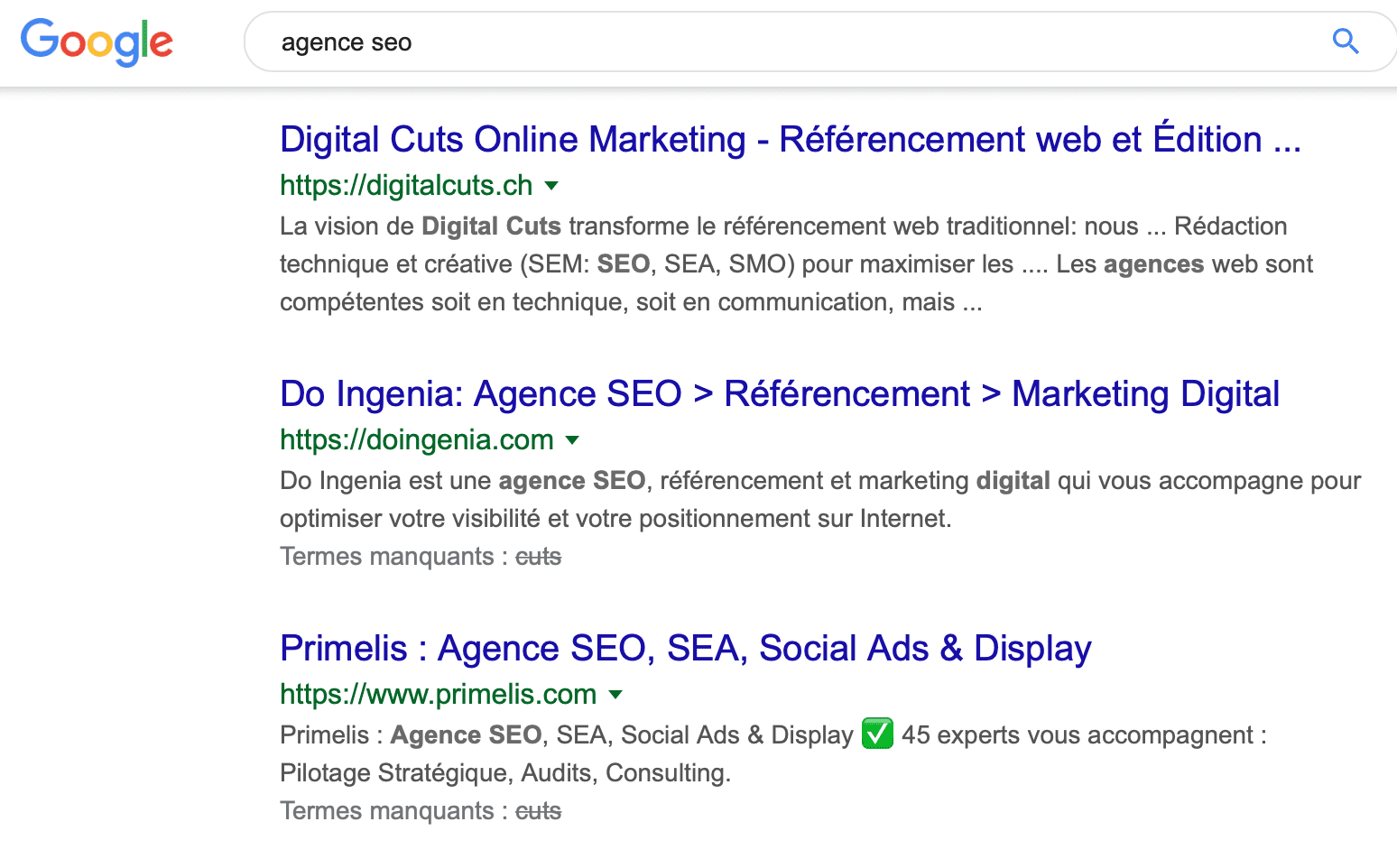
Note that results can vary depending on the internet user’s search history and location, as well as on changes to the algorithms. Results are specific to each person, for a better and more relevant experience. SEO can even be local, when searches depend on a town or a neighbourhood. Organic search is therefore a combination of factors and techniques to improve your ranking (position) in search engines.
More than 500 criteria used by Google to rank web pages
Google’s bots take several criteria into account – more than 500 – to index and rank pages. The work of an SEO specialist is therefore very complex if you want to reach the first page or, better still, the top of the search results. Whether you are a beginner or simply curious about the field, try thinking of a few criteria that Google’s algorithms consider when ranking web pages. Hint: always (or almost always) put yourself in the shoes of a website’s users. If they like you, the bots will (almost always) like you too.
The impact of SEO
Increasing traffic to your website
Well-executed SEO applied over the long term brings a considerable increase in traffic and popularity to a website. This increase can be beneficial for some and even vital for others, when you consider the business model of certain bloggers (who sell their traffic to advertisers or earn from affiliate products and links) or e-commerce websites. To track your traffic, there is nothing better than harnessing the power of Google Analytics and Search Console – tools we use both to monitor and to optimise our clients’ organic search. The next impact follows directly from this increase in traffic.
Branding and business development
SEO is a major asset for a company’s reputation and image. Neglected SEO can cost a business visibility as well as reputation. So it is important to exist online when people search for you – at the very least for your brand name. All too often, we meet small and medium-sized companies that have a website but cannot be found on Google. The only way to find their website is to type the exact address (URL) into the browser.
Destroying a business
If you are still stuck on our little exercise about the ranking criteria Google takes into account, here is one for you: the speed of your website. Did you know that Amazon would lose more than CHF 1.5 billion if its website slowed down by 0.1 seconds? Yes, SEO can completely wipe out a business. If a website’s optimisation no longer suits Google and Google penalises or demotes it, it will lose positions. Losing positions means losing traffic and, for an online shop for example, a drop in revenue. Some businesses therefore depend entirely, or almost entirely, on SEO. A risky bet when you see how the field is evolving...
How organic search is evolving: changes and trends
Increasingly complex mechanics
Search engines have never stopped evolving since they began. Google is the most complex and the most advanced. It uses more than 500 criteria to assess and rank a website for a given query. In the past, all you had to do was stuff your website and its pages with keywords (keyword stuffing) to rank for that keyword. Quantity came before everything else. It is easy to see why that era is over: it guaranteed users absolutely no relevance. Now the focus is on quality content, technical quality, user experience (UX) and the links pointing to your website (backlinks). The algorithms are developing and taking increasingly qualitative criteria into account in order to deliver ever more relevant results. Google updates its algorithm every day in its quest for ever greater relevance, but also to avoid becoming too predictable for SEO experts. On 25 October 2019, Google revealed that it had carried out its biggest algorithm update in the last five years. The search engine announced the launch of BERT, which stands for Bidirectional Encoder Representations from Transformers. The aim of this update is to better understand the natural language used by internet users. In practical terms, Google wants to grasp the real meaning of a query more accurately, such as negations. Previously, negations were not always understood and Google could serve up results that said the opposite. With BERT, the user’s ultimate intent is now better understood.
Search engine algorithms – Google’s in particular – are evolving faster and faster. Every day they challenge the work of SEO specialists, who must adapt, react and constantly stay alert. In recent months we have, unsurprisingly, spotted one major trend in SEO and how it is evolving. What is it? You! Google is turning more and more towards the user and their search and browsing experience on a website. Google recently updated its Google Search Console with new features that measure Core Web Vitals, with one ultimate goal: optimising the user experience (UX).
Ever fiercer competition
When you look at the number of results Google offers, you quickly realise how many pages are trying to rank for any given query. Google’s index contains more than 130 trillion pages. That staggering figure reflects the ever-growing digital presence of all kinds of players today. Another factor is that awareness of SEO’s impact has boomed in recent years. It has become a profession in its own right. It is not easy to hold your own against more and more competition. Take a fitness coach who wants to create a website. To gain a little visibility and win clients online, he will need to rank for main queries such as “fitness coach” followed by the name of his town. Without a minimum of work and method, that is simply impossible. That is why at Digital Cuts, our vision of a human–robot duality sets us apart and lets us offer an original method for better performance. Given the complexity of organic search, the competition and the constant changes, it is often difficult to optimise your website on your own. So to go further and get support, we offer training and coaching in various areas of digital marketing, including a dedicated course to learn SEO. We know that some companies and individuals do not have time to devote to training, which is why our SEO agency in Geneva can also handle your organic search for you, with complete transparency.
Voice search
It is booming! The rise of assistants and smart speakers such as Google Home is fuelling its explosion. More and more people are using voice search to find information or solve their problems. And in voice search, only one result is given most of the time. If you are in position 2, you are already nowhere – invisible. Cruel but true. SEO is constantly evolving, and so is technology. Organic search will live on, but always in a slightly different form, always a little more complex to tame and master. Those who adapt and work hardest will stand out and survive. The others will disappear.