We have no intention of writing an ultra-technical article on complex SEO methods. Instead, this is an educational guide to basic principles and easy-to-implement tips, designed to help everyone understand the subject and gain visibility on our favourite search engine. A few welcome, regularly updated tips to help you appear at the top of the search results and give your site’s traffic a fresh boost.
Ranking first on Google, yes, but in organic search or paid search?
Before working out how to appear at the top of Google, you first need to decide which part of the Google results page you want to lead. Google shows so-called organic results, which is what we call SEO, or organic search. But above them, as you can see below, Google sometimes displays paid ads, which is what we define as SEA, or paid search. The choice depends on your strategy and your budget.
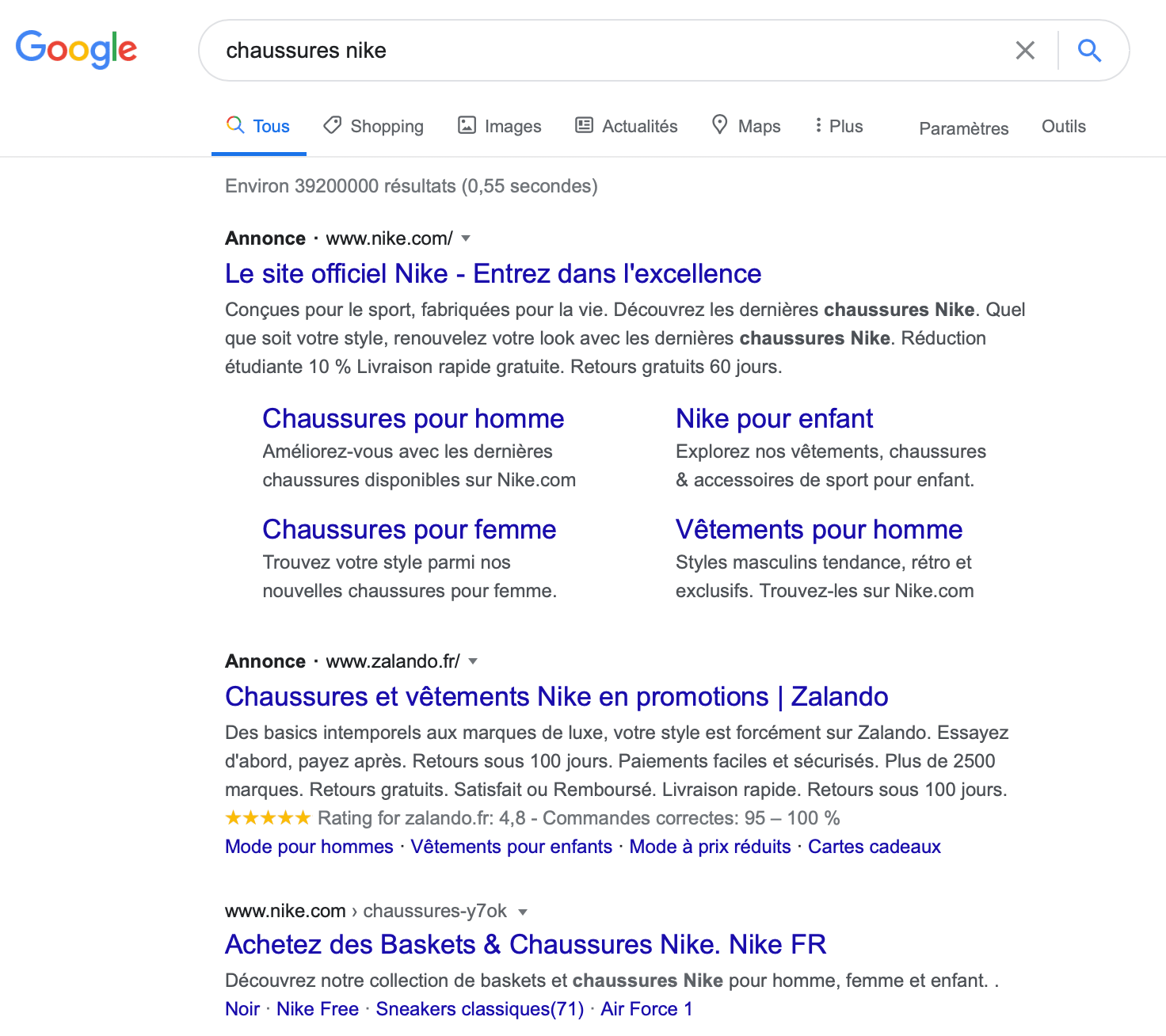
Paying to rank first on Google (NOT always) with SEA
Each of these marketing techniques has its advantages and drawbacks. Paid search lets you reach the top of the search results very quickly. But to do so, you have to pay Google for every click you get and write your ads in Google Ads.
SEO: long-term, quality work
Organic search, on the other hand, takes longer, depending on the topic and the size of the website. It can take up to 12 months to achieve substantial results and appear on the first page of Google, or better still, among the very first results. The advantage is that you never pay for a click and, if you do it yourself, it is “free” and can be extremely powerful in the long run as part of an inbound marketing strategy.
What they have in common
The trap is thinking that SEA is simple and SEO is technical. Not so: both are technical and complex, but they have a few things in common. They take work, yet they are within everyone’s reach, and both can deliver significant results.
Which should you choose?
Our first piece of advice, then, is to define your strategy and choose your target placement, weighing up the pros and cons of SEO and SEA against your goals and business model. Am I a small business with a showcase website, an individual with a portfolio, a blog, a media site or an e-commerce store? Most of the time, combining the two seems to us a good starting point to take off while SEO kicks in and the site starts climbing the search results. This article covers SEO only, and we encourage you to read up on the pitfalls of SEA and our tips for optimising your Google Ads campaigns so you can reach the very top of the paid results without overpaying per click.
How to reach the first page of Google for free, in other words with organic search
When it comes to SEO, if you want to appear on the first page, or even at the very top of the search results in 2026, you need to combine several interlocking aspects, or pillars, to achieve convincing results. To rank well on Google, it is important to grasp the user’s search intent and answer it with relevant content, built around solid authority and essential technical factors. So where do you start?
No visibility on Google without a solid SEO strategy
Everything starts here. A site without a strategy will not be able to “rank”, or even position itself properly. The strategy is the definition of the goals and the queries, the words, you want to rank for whenever someone types them into Google or another search engine. To help you with your keyword research, various free tools are available, such as Google Keyword Planner or Answer The Public. You can also use the Google search bar (Google Autocomplete) to find out what people type around your topic or core search. For example, imagine you want to be on the first page of Google for the search “digital marketing training”. Users will search for this service in different ways, and Google Autocomplete shows you how:
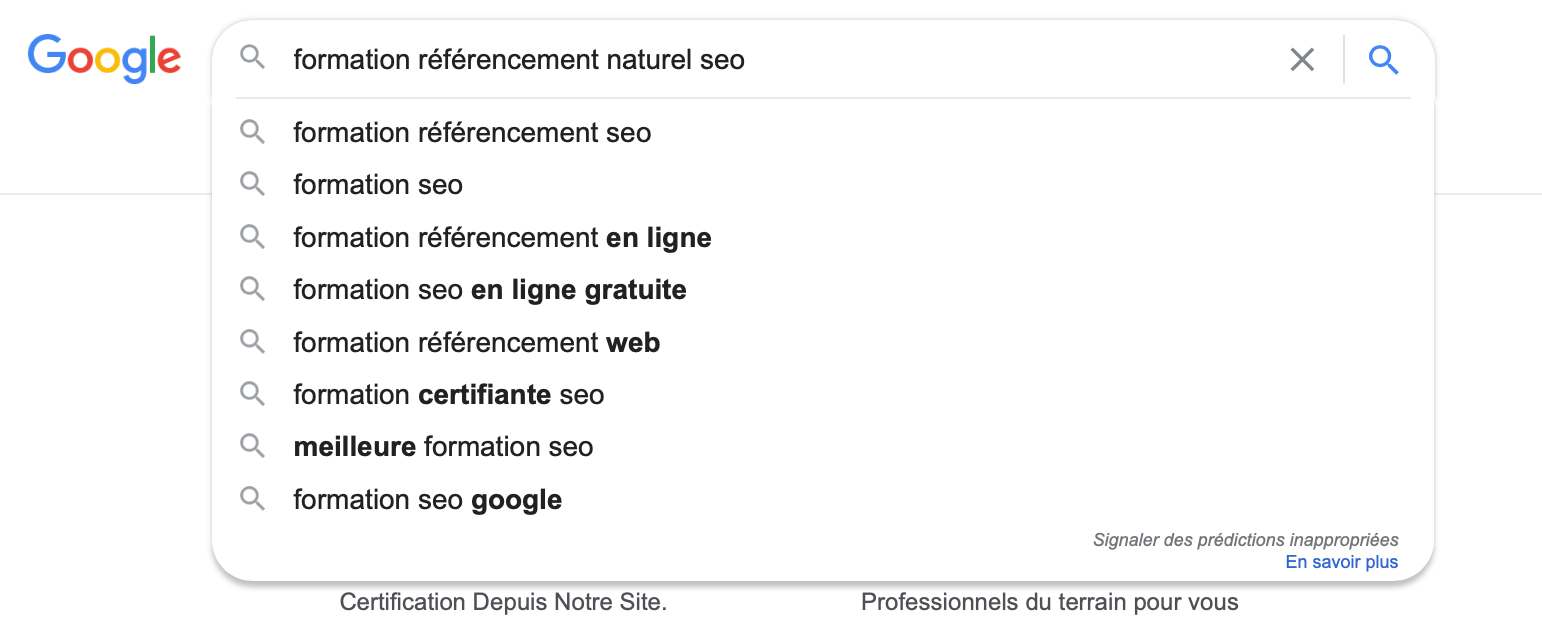
Today, it is vital to understand the user’s intent so you can answer it as well as possible on your web pages, using the right content and semantic field.
Content: the heart of good Google SEO
Content that matches search intent
To know how to reach the top of Google, keep in mind that content plays a leading role. It naturally flows from the strategy, and it is created to address a problem, the intent behind the user’s search. Good content answers an intent expressed through a particular search. Is the user looking to buy a product, hire a service, get advice or find specific information? It is up to you to be the best at answering their query.
Quality content
Content must therefore be rich, engaging, illustrated with images, infographics or videos, and of high quality to satisfy the user’s search. That is why we advise against stuffing your content with too many keywords, which degrades its quality. When you write, do everything for the user and not just for Google, because Google itself, with its various updates, is increasingly trying to think like a user and understand their behaviour. Taking care over your titles and descriptions is also very important for ranking at the top of Google.
In SEO, content is written in the body of the page, but also in certain HTML tags and attributes. To go further, we recommend Rudy Viard’s guide, which explains how to rank first on Google with relevant examples and case studies.
Update your content
What’s more, updating your content regularly and publishing new material will give your SEO a boost. That is why adding a blog is often recommended for a site that wants to increase its visibility on Google. There are always relevant ways to feed your site and show search engines that you are still active!
Beware of duplicate content
Finally, avoid duplicating content and overusing copy and paste, whether within your own site or by lifting it from external sources. It’s your content, your service, your product, your blog! Showcase your authenticity and your expertise.
Links: a key factor in reaching the first page of Google
Building sound internal linking
Internal links are the links on your website that point to other pages on the same site. Internal linking is a powerful lever that improves navigation for both users and Google’s bots. Good internal linking means links to important and, above all, relevant pages on your site. Placement matters too: favour links within the text content of your pages, as in the Wikipedia example below:
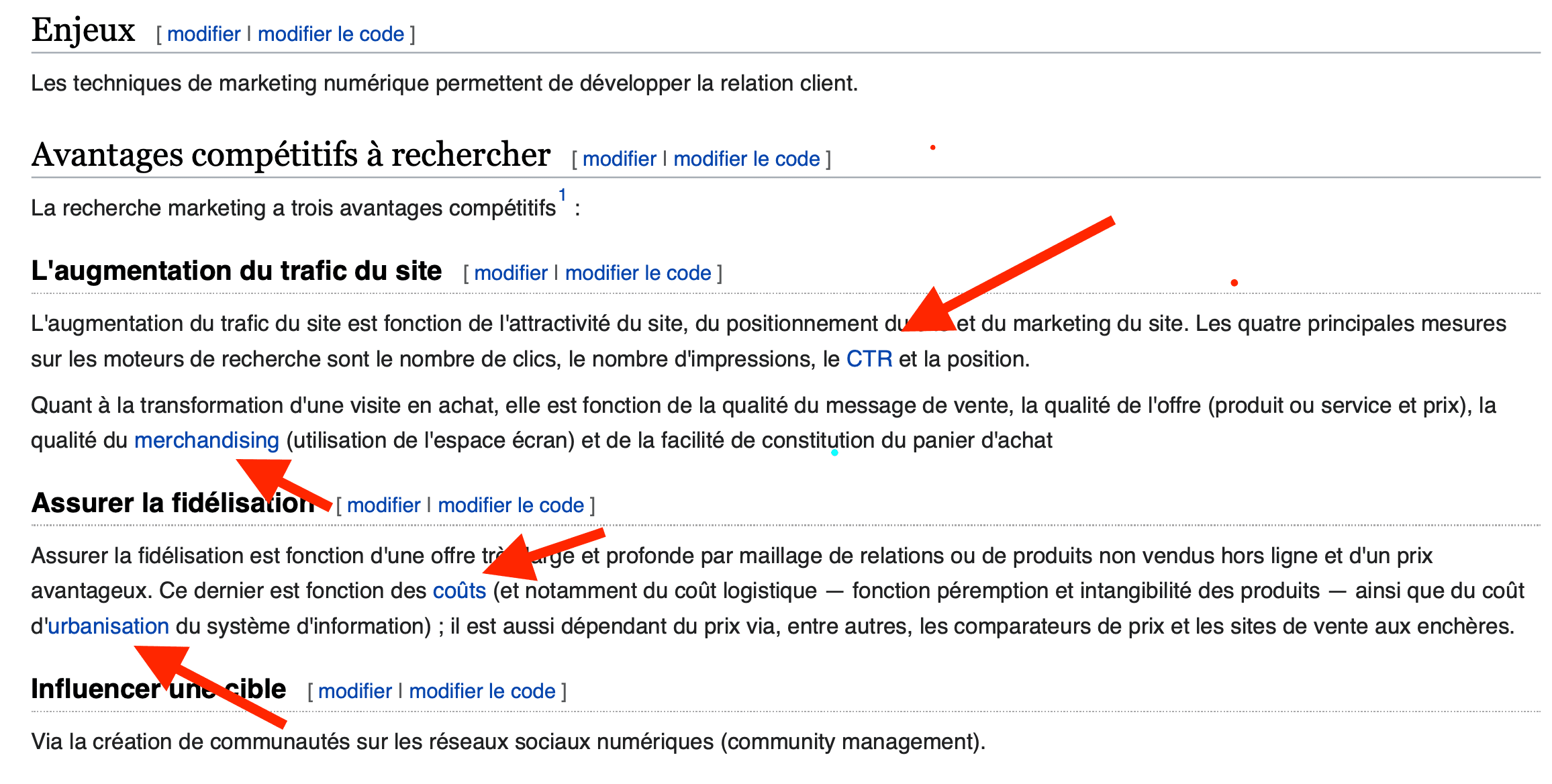
The quality of backlinks
Backlinks are links pointing to your site from other sites. They reflect your site’s authority. But far more than quantity, you need good-quality links. So getting backlinks is good, but not just any backlinks. Quality comes from semantic relevance, the placement of the link and the authority of the linking site. External links pointing to you should look natural and consistent. To get an overview of your link profile, Ahrefs will be your best ally. Bear in mind that acquiring good links is essential to appear first on Google for competitive searches. On the other hand, links are not essential to reach the top of Google for less competitive, niche queries.
Technical SEO and UX (user experience): not to be overlooked if you want to rank first on Google
Clean code and choosing a template
More and more often, websites are built with a CMS (Content Management System), the best known being WordPress. Agencies and individuals pick a template and customise it to save time. Be careful, though, to choose a template with clean code, as poor code can cause problems for Google’s crawl (the scan of your site by bots) and therefore for your SEO. Of course, quality content will make the difference, and SEO is not just about clean code, but choosing a clean template gives you a solid start. Various online tools can assess how clean your HTML, CSS or JavaScript code is, such as the W3C validation tools.
SSL certificate and security for greater trust from algorithms and users
An SSL certificate is a small file that switches your site to “https”. It is a prerequisite, a “must-have”, for every website in 2026, as it plays a major role in users’ trust. It also has a positive impact on your SEO. So don’t neglect it: install it. An SSL certificate can be free, such as the one from Let’s Encrypt, and easy to install on your web server. You can check that your site is secure by looking for the small padlock at the top of your browser, as shown below:

Site speed for a better user experience
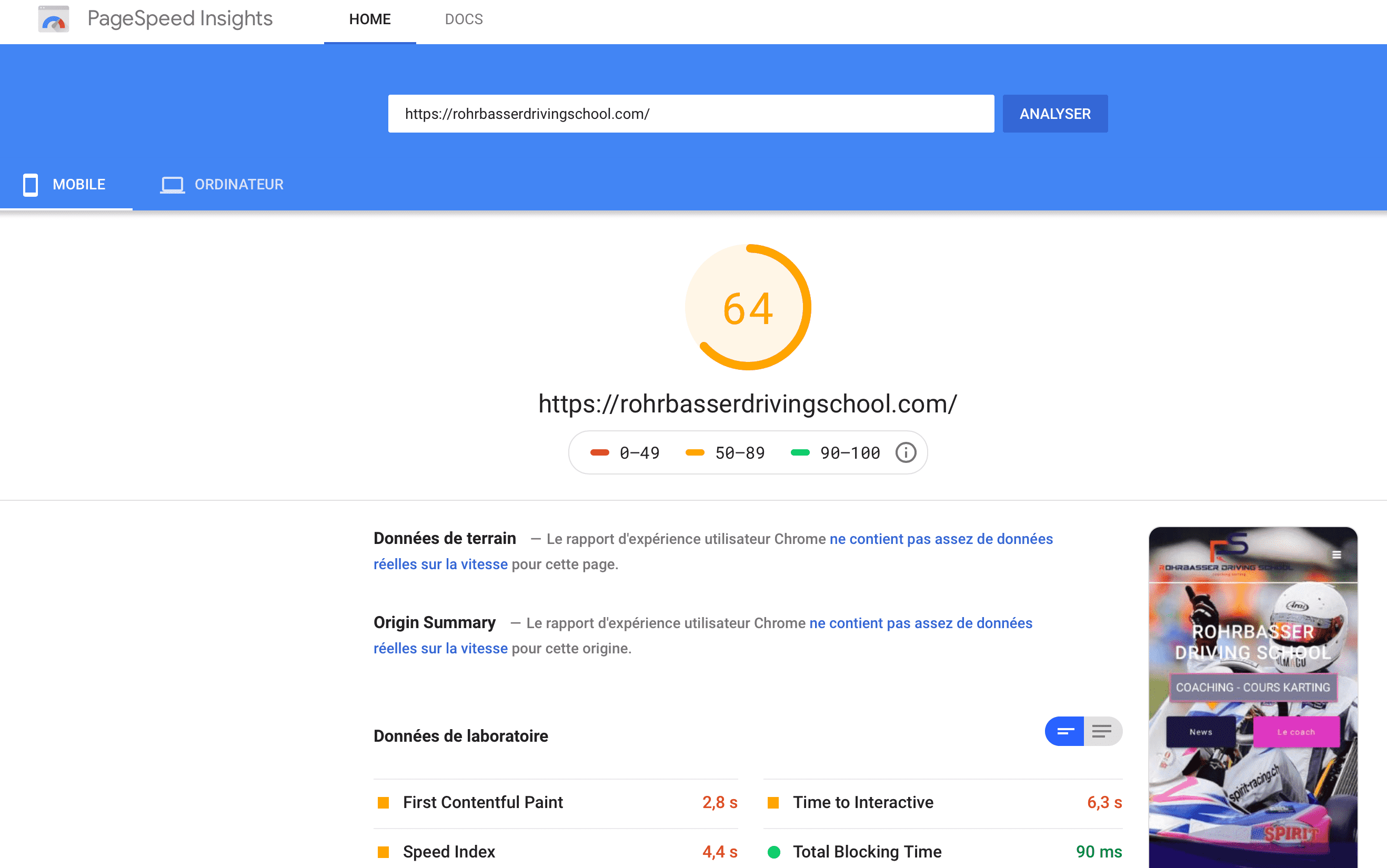
Speed and performance! That is what every user expects from a website, and so does Google! That is why you need a site that loads quickly. This is increasingly true given the latest algorithm changes, which aim to answer users’ queries ever faster. To achieve this, avoid overloading your site with unnecessary plugins, compress your images, use lazy loading, enable caching and minify your HTML, CSS and JavaScript files to speed up loading times. Don’t hesitate to test your website’s speed and discover some opportunities for improvement.
Mobile responsiveness: essential for SEO
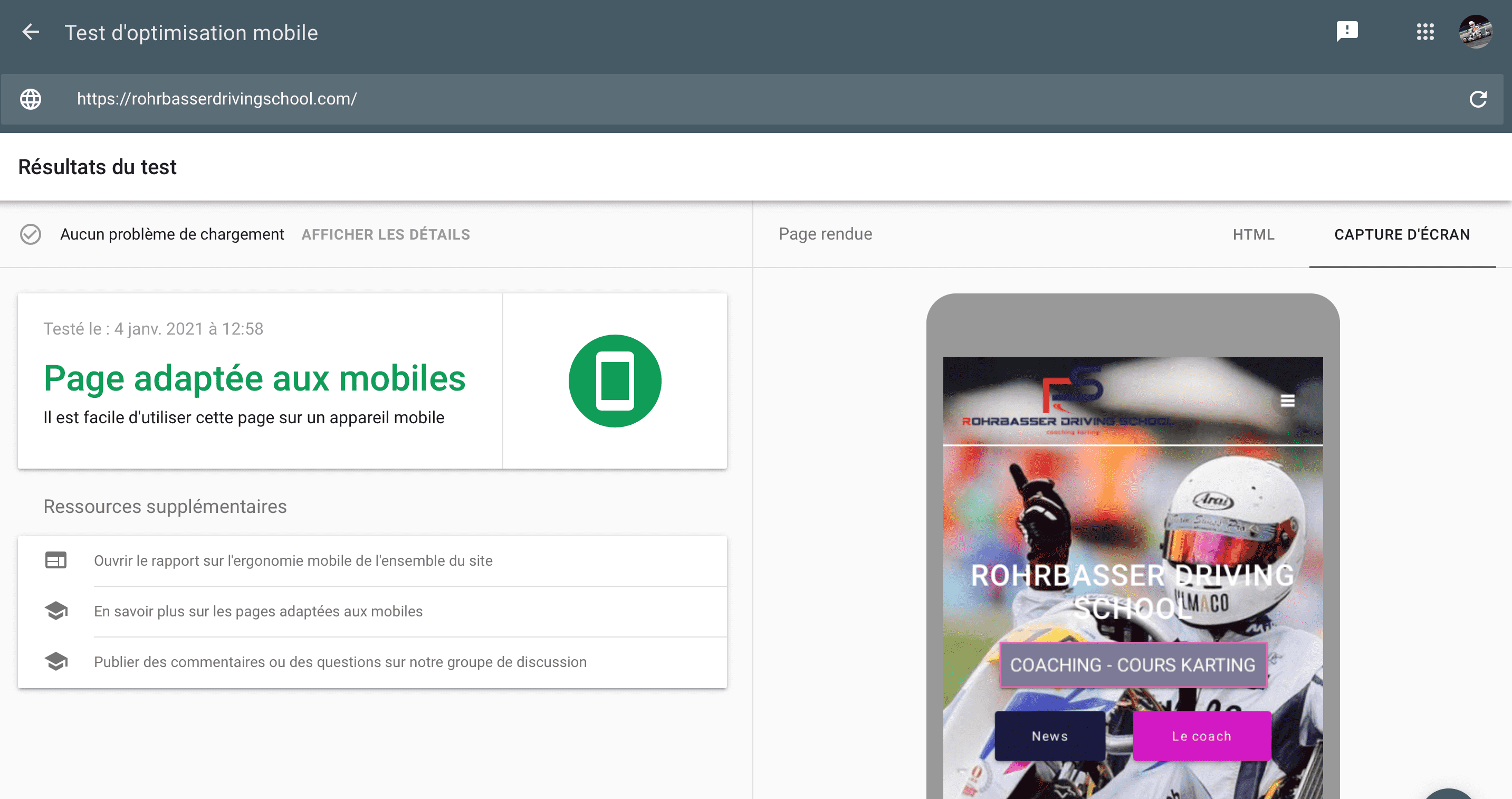
This criterion also reflects how people’s use of the web has evolved. More and more often, if not mostly, they use their mobile phones to find information, buy a product or contact a business. That is why Google places enormous importance on websites that adapt properly to mobile devices. Make sure yours does by choosing a responsive template or hiring a developer. Test it right now to check whether your pages are mobile-friendly.
To be ranked, you first need to be indexed
Everything we have just described is useless if our quality pages are not indexed. This is the concept of indexing. The word may sound strange, but it simply means being accessible via Google. If, despite all our efforts, Google decides not to place our content (pages) in its index, we will be impossible to find through this channel. So before being first, you need to be indexed. This criterion is important and all too often forgotten. Publishing your site is not enough: it helps to introduce it to Google through the features of Search Console or to obtain links pointing to your website. Google is a spider that travels from link to link to discover and index the web. Often, especially at the beginning, getting links is difficult, and sometimes we want to quickly index a freshly published article because it has potential and is of high quality. Don’t wait any longer: ask Google to come and see your content and index it, using that famous Swiss Army knife, Search Console.
Working with an SEO agency
Very often, when competition is fierce, reaching the top spot on Google takes much more than simple technical and content optimisation. It is long-term work for experts. For strategic, lasting support, working with an SEO agency in Geneva is often the key. Our experts help you build strong local visibility, based on concrete data, targeted content and a tailor-made organic search strategy.
In short, to be number one there is (almost) no secret: work, optimise and analyse to reach the top of Google’s search results
Work regularly and consistently, because SEO and SEA are never set in stone. They are constantly evolving, which is why you must never stop monitoring and optimising. Understand what works and what doesn’t, so you can keep improving your organic and paid search with tools such as Google Search Console, or by using Google Analytics. These are truly essential levers in digital marketing and web visibility strategy.
Don’t give up! And if you’re keen to go further and want to put these tips and methods into practice to improve your Google rankings, we are here to train you in SEO and support you.
Despite all these tips and advice, ranking matters but is not enough: what counts most is the quality of the traffic reaching your site. And never forget to step back from these methods and ask yourself: why should my site be first rather than another?
The higher you rank in the results, the bigger your share of the traffic.
| SEO · organic search | SEA · paid search | |
|---|---|---|
| Time to results | Gradual, up to 12 months depending on the topic and the size of the site | Fast, as soon as the campaign goes live |
| Cost per visit | No pay-per-click | You pay for every click |
| How long results last | Long term, results build up over time | As long as the campaign is running |
| Levers | Technical, content, popularity | Budget, keywords, ads, targeting |