SEA is a digital marketing method that involves paying a search engine, such as Google or Bing, to appear in its search results or in other placements.
What is paid search? A definition of SEA
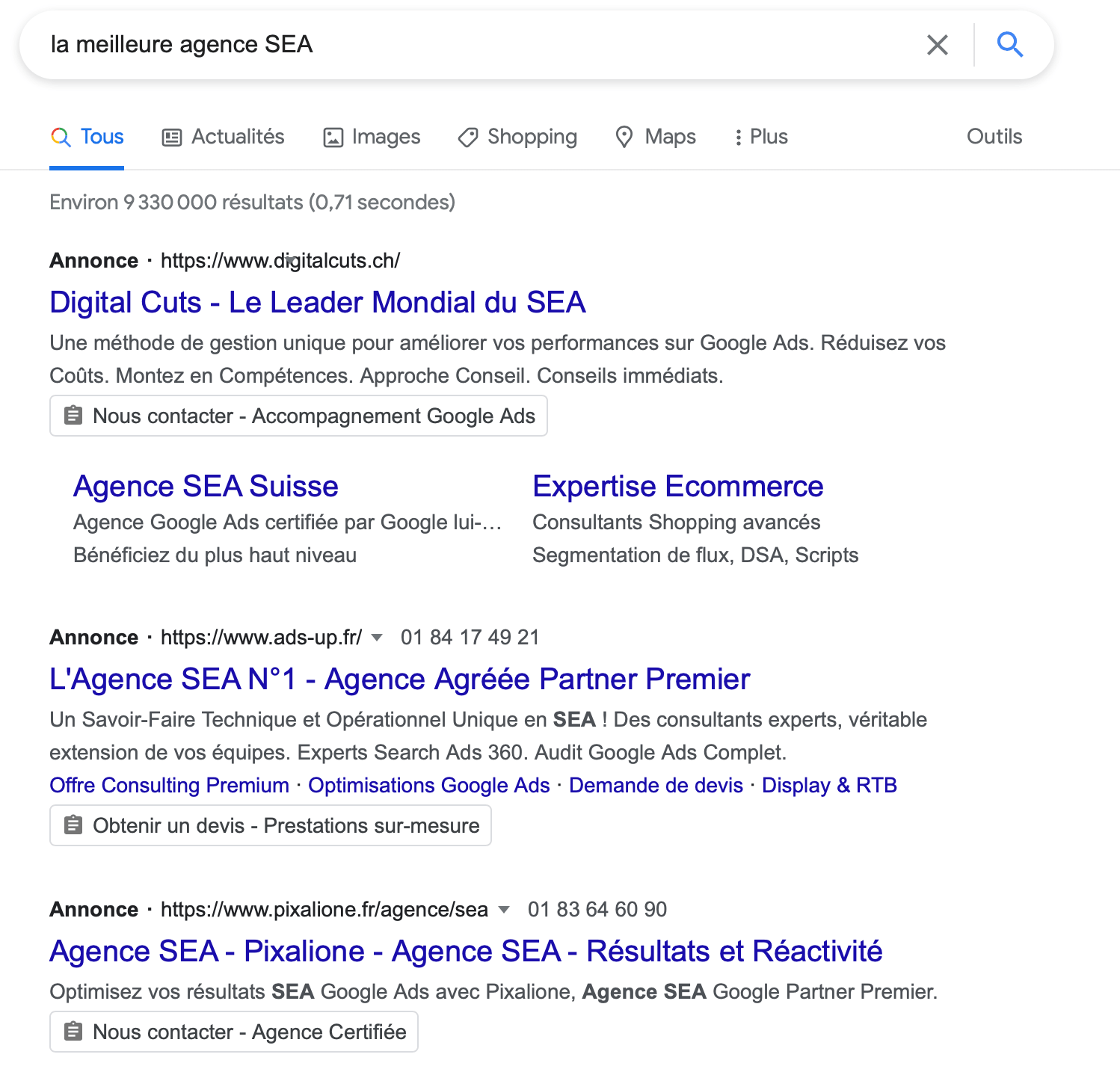
/SEA stands for Search Engine Advertising, also known as paid search. The definition of SEA lies in its purpose: paying a search engine, usually Google, to position a website better in web search results in order to drive visits and sales. Broadly speaking, paid search means paying to show ads quickly and in the best possible position. The screenshot below shows a few examples: 3 paid ads for the French query “la meilleure agence sea” (“the best SEA agency”). You can spot them by the small black Annonce (Ad) label to the left of each result. Only below them, in 4th position, comes the first organic (unpaid) result. In some sectors, such as emergency services, it is essential to appear in this space dominated by paid ads, or you risk being invisible to a large number of potential customers.
 Search engine results pages are one place where ads are displayed, but there are others, such as partner websites in the Google network. This is known as the Display Network. Here’s what it looks like:

Here, the advertiser, a watch brand, has chosen the Display Network to run its ad: it appears on other websites. Running paid ads in search results and/or on other websites is the very definition of paid search.
How do you do paid search?
Once you know what SEA paid search is, the next question is: how do you actually run this kind of ad? Or: which tool should you use? And above all, to go further: what strategy should you adopt for SEA paid search?
There are two main tools, or rather two platforms. If you want to show your ads in Google search results and on its Display Network (on other websites), you’ll need to use the Google Ads platform. If, on the other hand, you want to show them on the Bing search engine, you’ll use Bing Ads. These online platforms let you write your ads and choose where they appear, your budget and your target audience. Paid search can extend even further, for example to Amazon. This huge e-commerce site offers a paid solution for ranking higher on its site when a user searches for a product. Search ranking is everywhere, whether it’s organic (SEO) or paid.
How SEA paid search works: the big picture
People often wonder how Google, a free tool, can be one of the biggest presences in the world and earn so much money. Do you know the answer? It’s mainly thanks to SEA. Given how relevant the search engine and its results are, its use is immeasurable. The number of advertisers using the platform is huge: millions of people pay Google to be visible online. But how does it work?
Cost per click
Imagine you show an ad to everyone searching from Geneva only (targeting can be very precise): you pay only for the click (a cost model known as CPC). This means you pay if, and only if, someone clicks on your ad: the number of times the ad is viewed is not charged. However, for competitive queries such as “serrurier geneve” (locksmith Geneva), a click can cost more than CHF 20. That’s why it is so important not to neglect the preparation and monitoring of your SEA paid campaign. We recommend working with specialists to get the best results from Google Ads without blowing your budget.
Choosing keywords
Understanding the cost-per-click model is essential, especially when choosing the keywords you want your ads to show for. The broader and more competitive the keywords, such as “shoes”, the more expensive the click. Keyword choice is strategic and must match your targeting. It is also the starting point for writing your ads.
Targeting
Google Ads, Bing Ads and other SEA platforms let you choose where and to whom you show your ads. And yes, you obviously don’t have to show them to the whole world – which would be a mistake anyway. Depending on your business, product, strategy and budget, you’ll choose different targeting. The key thing to understand is that you can precisely target location, demographic criteria such as gender and age, and even the type of device used to go online, among other things.
Writing your ads
Once you’ve chosen your keywords and defined your audience targeting, the last key step is writing the ads: what your targeted users will read. The copywriting is therefore crucial, so that it stays as consistent as possible with your goals and your offer while encouraging quality clicks that generate as many conversions as possible. SEA is one of the most cost-effective modern advertising methods, even on a modest budget.
Measuring results and optimising
Once your campaign is live, it is essential to track its results closely. Auditing performance lets you optimise your paid search campaigns and better understand what works and what doesn’t. You can follow your progress directly in the Google Ads platform, but you can go further by using a complementary audience measurement tool: Google Analytics. Does all this sound complicated and risky? It’s what we do. At Digital Cuts, we’re here to advise you, support you and get the job done. Contact us to launch a campaign and optimise your returns, or take our Google Ads training courses. Your new customers are just a click away.
| SEO · organic search | SEA · paid search | |
|---|---|---|
| Time to results | Gradual, up to 12 months depending on the topic and the size of the site | Fast, as soon as the campaign goes live |
| Cost per visit | No pay-per-click | You pay for every click |
| How long results last | Long term, results build up over time | As long as the campaign is running |
| Levers | Technical, content, popularity | Budget, keywords, ads, targeting |
Ad Rank = bid × Quality Score: a relevant ad can outrank a higher bid.